
Trauma
Sterile Bone Fixation Element with Hydroxyapatite
The commercial models that make up the Sterile Bone Fixation Element with Hydroxyapatite family are defined as fixation devices, classified as long-term surgically invasive implantable medical devices.
Technical information
Everything the surgical team needs to know.
Overview
The commercial models that make up the Sterile Bone Fixation Element with Hydroxyapatite family are defined as fixation devices, classified as long-term surgically invasive implantable medical devices.
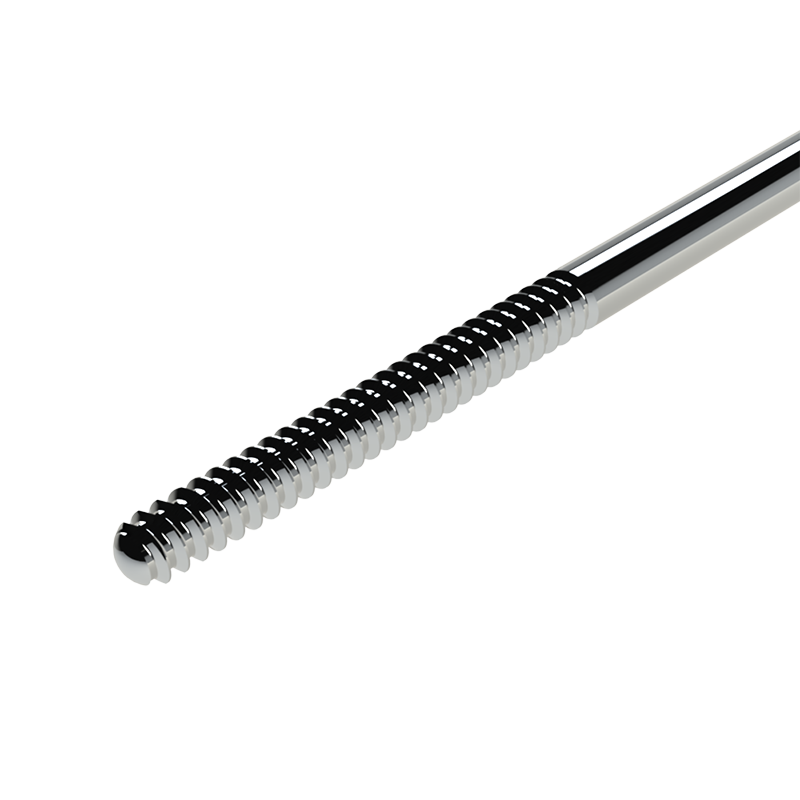
The Sterile Bone Fixation Element with Hydroxyapatite is also considered a partially threaded transcutaneous pin, referred to as an anchoring element for the external fixation system, also known as a threaded pin, Schanz pin, etc.
The mechanism of action of the pin in the bone is to: stabilize, restrict or control the movement of bone fragments, assist in fracture reduction, correct or control alignment, provide stability to the affected region, and allow safe placement in relation to adjacent structures.
The design and use of these bone fixation medical devices are based on an understanding of bone healing and of the loads and forces to which the implant is subjected. During insertion, the pins are subjected to axial compression, axial tension, torsion and bending forces due to the resistance of the assembly around axes parallel to the pins. The Pin was designed to withstand these loads and therefore contributes to structural stability as well as to the transmission or relief of mechanical loads on the affected bones.
The threaded part of the pin is implanted in the patient's bone, while the smooth part is attached to the External Fixators (ancillary components).
The threaded part receives a Hydroxyapatite coating to increase the pull-out strength of the pins, which is extremely useful, especially in situations of prolonged use, such as deformity correction. Hydroxyapatite provides greater osseointegration and, consequently, increased overall stability and reduced pin-tract infection.
Hydroxyapatite-coated pins have shown lower loosening rates, reduced infection rates, and even a lower incidence of secondary deformity during lengthening.
Indications
The Sterile Bone Fixation Element with Hydroxyapatite is indicated for the treatment of fracture, stabilization, stretching and bone transport, and can be used in small, medium and long bones in the extremities of the human body.
Materials
Stainless Steel F138 (ASTM F138) and Hydroxyapatite (NBR ISO 13779 Parts 2 and 3)
Components
Components and codes
1 code available in this system.
| Code | Description | ANVISA | Qty |
|---|---|---|---|
| NA | Consulte um de nossos vendedores para maiores informações. | 80083650077 | 1 |
No component found. Try another code or term.
Technical catalog
Product catalog
Codes, dimensions and instruments for the line in a single PDF.

Product catalog
Sterile Hydroxyapatite-Coated Bone Fixation Pins
ASTM F138 stainless steel bone pins coated with hydroxyapatite, sterile (EtO), for use with external fixation systems in fracture fixation. Diameters from 4.0 to 6.0 mm, tapered thread and calibrated versions, with code tables.
Instructions for use
Instructions for use and documents
Official PDF files, with revision and ANVISA registration.
Quote
Request a quote.
Tell us what you need about Sterile Bone Fixation Element with Hydroxyapatite. The Sartori sales team replies with a proposal, availability and technical support.
- Direct contact with the factory sales team
- Technical visits and complementary materials
- For hospitals, distributors and surgeons
ProductSterile Bone Fixation Element with Hydroxyapatite