
Implants • Trauma
Titanium Locked Intramedullary Nail
Description
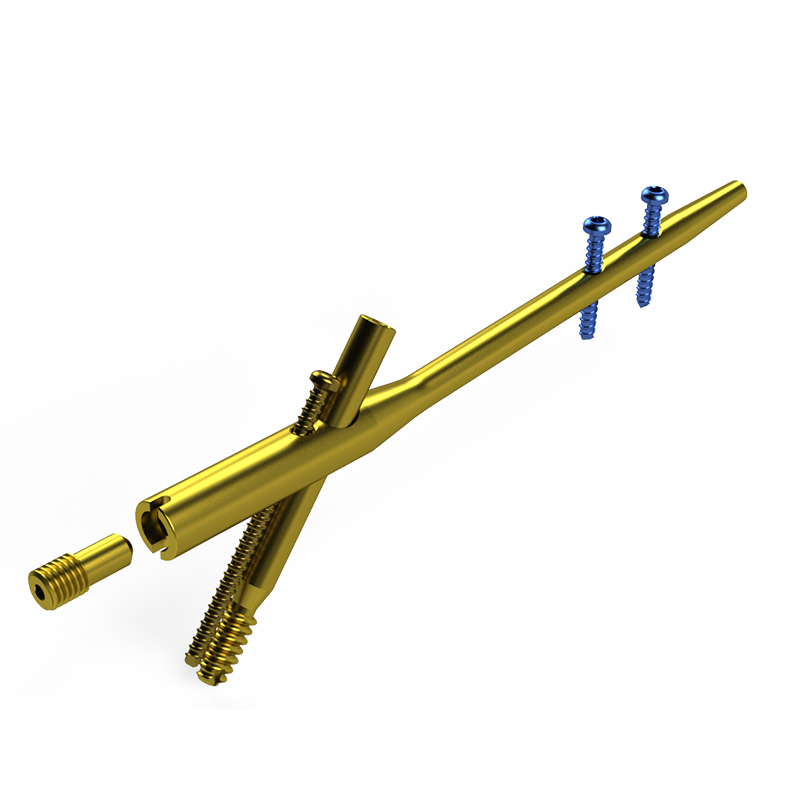
The commercial models that make up the Blocked Intramedullary Nail family consist of surgically invasive implants for long-term use, developed for application in bone fixation through intramedullary blocking, with the purpose of reducing, aligning, stabilizing and fixing various types of fractures, in medium and large bones, of lower limbs such as the femur and tibia, accompanied by a cap screw and anti-rotational locking screw (when applicable), and used in association with the ancillary components: Screw Blocking Device for Intramedullary Nail (ancillary component and not part of this product), according to the indication for use.
The Buffer Screws and the anti-rotational locking Screw (when applicable) form a single composite product with the Intramedullary Nails, maintaining an interdependent relationship to obtain the functionality and performance for which it is intended. Its function is to prevent bone formation and tissue invasion in the connecting part of the instrument, so as not to hinder removal, and cannot be sold separately.
The working principle of the intramedullary nail is similar to a tube within another tube, providing support and stability to the fixation. To achieve rotational stability, the rod relies on friction and interdigitation of fracture fragments, as well as contact extension for greater resistance to tilting and bending. To increase the contact area, intramedullary milling is often used, as this procedure enlarges the medullary canal to allow the insertion of the nail, in addition to being large enough to provide stability, it is also strong enough to assume the function of the bone, which is to act as a support structure and transmit load. This maintains or restores stability in the affected region, with the aim of preventing or correcting injuries of various etiologies.
The product consists of a semi-rigid fixation system in which the longitudinal component is a solid or cannulated Intramedullary Rod, accompanied by the Cap Screw and anti-rotational locking Screw (when applicable), with exclusive blocking by a transverse access screw called Locking Screw (ancillary component), in the Femoral and Tibial region. The product is designed to withstand axial compression, bending and torsional loads. In this way, it immobilizes the bones and transmits or relieves mechanical loads on the bone.
The product is characterized by supporting mechanical efforts in the required proportion, presenting an elastic modulus and interfaces with the bone, suitable for the transmission of forces in the bones, being biocompatible and adapting to the bone geometry of structures such as the tibia and femur.
The Buffer Screws and the anti-rotational locking Screw (when applicable) form a single composite product with the Intramedullary Nails, maintaining an interdependent relationship to obtain the functionality and performance for which it is intended. Its function is to prevent bone formation and tissue invasion in the connecting part of the instrument, so as not to hinder removal, and cannot be sold separately.
The working principle of the intramedullary nail is similar to a tube within another tube, providing support and stability to the fixation. To achieve rotational stability, the rod relies on friction and interdigitation of fracture fragments, as well as contact extension for greater resistance to tilting and bending. To increase the contact area, intramedullary milling is often used, as this procedure enlarges the medullary canal to allow the insertion of the nail, in addition to being large enough to provide stability, it is also strong enough to assume the function of the bone, which is to act as a support structure and transmit load. This maintains or restores stability in the affected region, with the aim of preventing or correcting injuries of various etiologies.
The product consists of a semi-rigid fixation system in which the longitudinal component is a solid or cannulated Intramedullary Rod, accompanied by the Cap Screw and anti-rotational locking Screw (when applicable), with exclusive blocking by a transverse access screw called Locking Screw (ancillary component), in the Femoral and Tibial region. The product is designed to withstand axial compression, bending and torsional loads. In this way, it immobilizes the bones and transmits or relieves mechanical loads on the bone.
The product is characterized by supporting mechanical efforts in the required proportion, presenting an elastic modulus and interfaces with the bone, suitable for the transmission of forces in the bones, being biocompatible and adapting to the bone geometry of structures such as the tibia and femur.
ANVISA
80083650048
Components and codes
34 items
Indications
The family of Locked Intramedullary Nails is used to perform bone fixation procedures through intramedullary blockage. It serves as a structural element within the medullary canal of long bones, in order to stabilize simple or complex fractures and pseudarthroses, in order to provide bone consolidation in the most physiological way possible.
The main objective of the Intramedullary Nail is to reduce, align, stabilize and fix different types of fractures, in medium and large bones, of the femur and tibia lower limbs.
The main objective of the Intramedullary Nail is to reduce, align, stabilize and fix different types of fractures, in medium and large bones, of the femur and tibia lower limbs.
Materials
Titanium Alloy ASTM F136n
Components and codes
| Code | Description | ANVISA | Qty |
|---|---|---|---|
| 0072310-220 | Haste Intramedular Bloqueada Femoral Proximal TI Ø10x220 | 80083650048 | 1 |
| 0072310-240 | Haste Intramedular Bloqueada Femoral Proximal TI Ø10x240 | 80083650048 | 1 |
| 0072311-220 | Haste Intramedular Bloqueada Femoral Proximal TI Ø11x220 | 80083650048 | 1 |
| 0072311-240 | Haste Intramedular Bloqueada Femoral Proximal TI Ø11x240 | 80083650048 | 1 |
| 0072312-220 | Haste Intramedular Bloqueada Femoral Proximal TI Ø12x220 | 80083650048 | 1 |
| 0072312-240 | Haste Intramedular Bloqueada Femoral Proximal TI Ø12x240 | 80083650048 | 1 |
| 0122020-025 | Parafuso de Bloqueio TI Ø4,5x25, Rosca Total, Autorroscante | 80083650062 | 1 |
| 0122020-030 | Parafuso de Bloqueio TI Ø4,5x30, Rosca Total, Autorroscante | 80083650062 | 1 |
View all (34)
| Code | Description | ANVISA | Qty |
|---|---|---|---|
| 0072310-220 | Haste Intramedular Bloqueada Femoral Proximal TI Ø10x220 | 80083650048 | 1 |
| 0072310-240 | Haste Intramedular Bloqueada Femoral Proximal TI Ø10x240 | 80083650048 | 1 |
| 0072311-220 | Haste Intramedular Bloqueada Femoral Proximal TI Ø11x220 | 80083650048 | 1 |
| 0072311-240 | Haste Intramedular Bloqueada Femoral Proximal TI Ø11x240 | 80083650048 | 1 |
| 0072312-220 | Haste Intramedular Bloqueada Femoral Proximal TI Ø12x220 | 80083650048 | 1 |
| 0072312-240 | Haste Intramedular Bloqueada Femoral Proximal TI Ø12x240 | 80083650048 | 1 |
| 0122020-025 | Parafuso de Bloqueio TI Ø4,5x25, Rosca Total, Autorroscante | 80083650062 | 1 |
| 0122020-030 | Parafuso de Bloqueio TI Ø4,5x30, Rosca Total, Autorroscante | 80083650062 | 1 |
| 0122020-035 | Parafuso de Bloqueio TI Ø4,5x35, Rosca Total, Autorroscante | 80083650062 | 1 |
| 0122020-040 | Parafuso de Bloqueio TI Ø4,5x40, Rosca Total, Autorroscante | 80083650062 | 1 |
| 0122020-045 | Parafuso de Bloqueio TI Ø4,5x45, Rosca Total, Autorroscante | 80083650062 | 1 |
| 0122020-050 | Parafuso de Bloqueio TI Ø4,5x50, Rosca Total, Autorroscante | 80083650062 | 1 |
| 0122020-055 | Parafuso de Bloqueio TI Ø4,5x55, Rosca Total, Autorroscante | 80083650062 | 1 |
| 0122020-060 | Parafuso de Bloqueio TI Ø4,5x60, Rosca Total, Autorroscante | 80083650062 | 1 |
| 0122020-065 | Parafuso de Bloqueio TI Ø4,5x65, Rosca Total, Autorroscante | 80083650062 | 1 |
| 0122020-070 | Parafuso de Bloqueio TI Ø4,5x70, Rosca Total, Autorroscante | 80083650062 | 1 |
| 0122020-075 | Parafuso de Bloqueio TI Ø4,5x75, Rosca Total, Autorroscante | 80083650062 | 1 |
| 0122020-080 | Parafuso de Bloqueio TI Ø4,5x80, Rosca Total, Autorroscante | 80083650062 | 1 |
| 0122020-085 | Parafuso de Bloqueio TI Ø4,5x85, Rosca Total, Autorroscante | 80083650062 | 1 |
| 0122020-090 | Parafuso de Bloqueio TI Ø4,5x90, Rosca Total, Autorroscante | 80083650062 | 1 |
| 0122020-095 | Parafuso de Bloqueio TI Ø4,5x95, Rosca Total, Autorroscante | 80083650062 | 1 |
| 0122020-100 | Parafuso de Bloqueio TI Ø4,5x100, Rosca Total, Autorroscante | 80083650062 | 1 |
| 0122020-105 | Parafuso de Bloqueio TI Ø4,5x10⁵, Rosca Total, Autorroscante | 80083650062 | 1 |
| 0122020-110 | Parafuso de Bloqueio TI Ø4,5x110, Rosca Total, Autorroscante | 80083650062 | 1 |
| 0122080-075 | Parafuso Deslizante para Haste Proximal TI Ø10,0x75 | 80083650062 | 1 |
| 0122080-080 | Parafuso Deslizante para Haste Proximal TI Ø10,0x80 | 80083650062 | 1 |
| 0122080-085 | Parafuso Deslizante para Haste Proximal TI Ø10,0x85 | 80083650062 | 1 |
| 0122080-090 | Parafuso Deslizante para Haste Proximal TI Ø10,0x90 | 80083650062 | 1 |
| 0122080-095 | Parafuso Deslizante para Haste Proximal TI Ø10,0x95 | 80083650062 | 1 |
| 0122080-100 | Parafuso Deslizante para Haste Proximal TI Ø10,0x100 | 80083650062 | 1 |
| 0122080-105 | Parafuso Deslizante para Haste Proximal TI Ø10,0x10⁵ | 80083650062 | 1 |
| 0122080-110 | Parafuso Deslizante para Haste Proximal TI Ø10,0x110 | 80083650062 | 1 |
| 0122080-115 | Parafuso Deslizante para Haste Proximal TI Ø10,0x115 | 80083650062 | 1 |
| 0122080-120 | Parafuso Deslizante para Haste Proximal TI Ø10,0x120 | 80083650062 | 1 |